
Gray Blending in Olmos Park: What It Is and Who It Suits
If the first thing you notice in the mirror is a stripe of gray at your part, gray blending is probably the service you have been after. It softens the line between your natural gray and the rest of your color, so grow-out stops looking like a mistake.
Gray color blending is one of owner Erika Valdez's own specialties at Zayda Hair & Apothecary in Olmos Park. It is also not the right call for everyone, and we would rather say that up front.
What does gray blending mean at the salon?
Gray blending is a color service that works with your natural gray instead of hiding it. We weave lighter and softer tones through and around your gray. Then we gloss everything to match, so the gray reads as dimension, not a root line. Full coverage paints over gray. Blending lets it stay, just quieter.
Here is why it works. Hair grows about half an inch a month. Gray strands have lost their natural pigment, so against a solid dark shade the new growth shows as a stripe within weeks. Blending skips the stripe. We move color around the gray so the eye has no hard edge to catch.
That is the difference from covering. Cover color sits at one flat depth from root to end, and every inch of regrowth announces itself. Blended color has movement. Your gray becomes one of the tones in it.
It also changes what maintenance means. With full coverage, the clock starts the day the color goes on. With a blend, the clock runs slower, because new gray lands in hair that already looks mixed.
How does gray blending work on your hair?
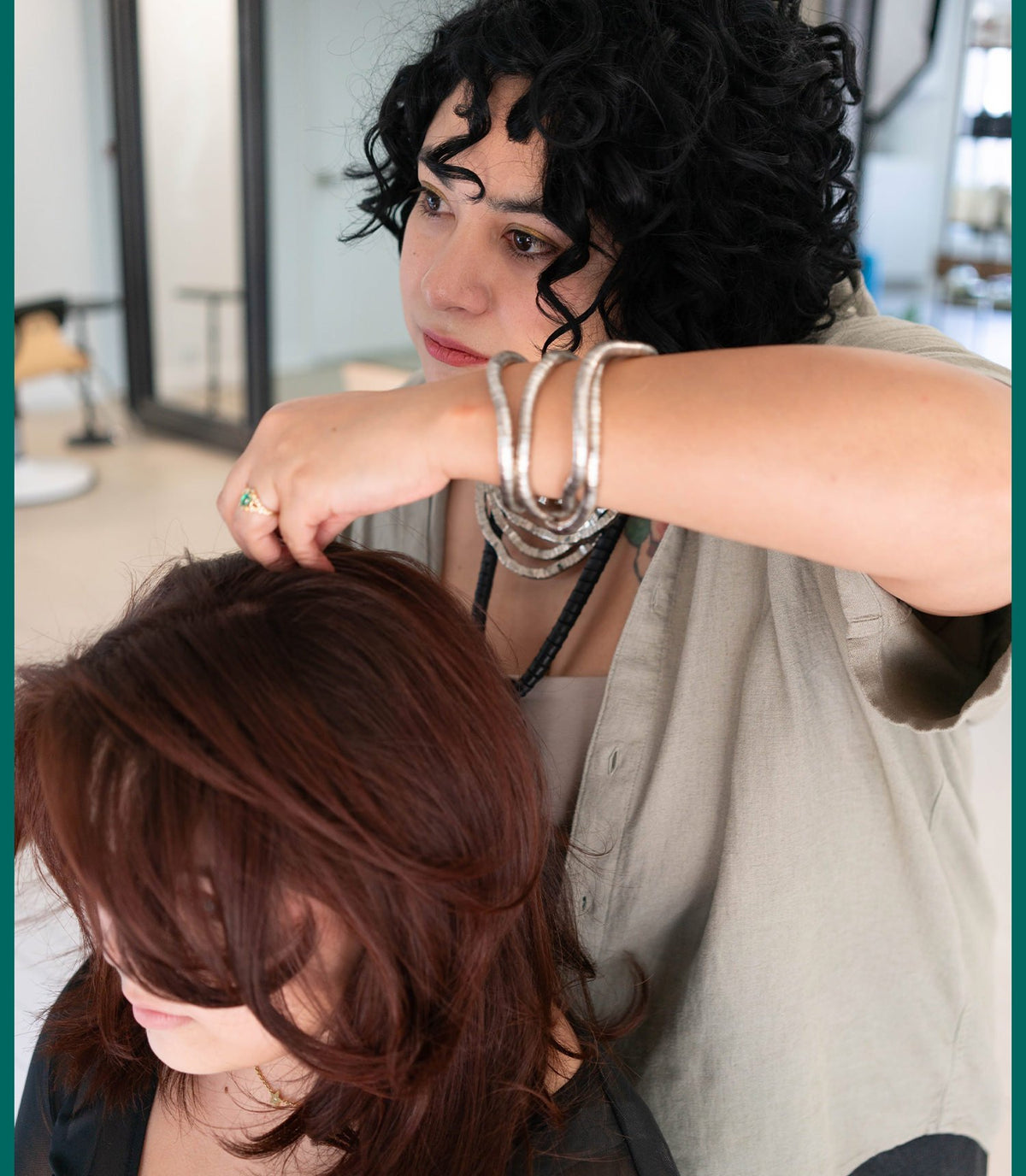
Three things happen in the chair: placement, gloss, and sometimes a soft root. Each does a different job.
Placement
We start by finding where your gray lives. It rarely grows in evenly. In our experience it gathers at the temples and along the part, with a scatter through the crown. Then we paint or foil fine pieces of lighter or deeper tone around those spots. The closer the surrounding tones sit to the brightness of your gray, the less your eye reads contrast.
Hand-painting is the same technique we describe in our guide to hand-painted balayage, just pointed at gray. Foils give a more defined result. Which one fits depends on the look you want.
Gloss
Next comes a gloss. It is a sheer, tone-adjusting color that goes over everything once the placement is done. It unifies the shade, adds shine, and calms strands that look yellow or wiry. Gloss fades gradually, which is why it is usually the first thing we refresh.
The soft root
Last, we soften the root where it helps. A slightly shadowed root means new growth melts into the hair instead of starting a fresh line. Not every guest needs one. We decide together at your consultation.
Should you blend your gray, cover it, or grow it out?
Each route is a fair choice, and the right one depends on how you feel about seeing gray. Here is how the three compare.
Gray blending
Blending suits guests who want effortless, natural looking color and are tired of a root line. It usually stretches the time between visits compared with a root retouch. The exact interval depends on how fast your gray grows and how much contrast we started with. Expect a gloss refresh along the way to keep the tone clear.
Full gray coverage
Our gray root retouch paints your regrowth back to one solid shade. It suits you if you want no gray showing at all. The tradeoff is the line. It returns on the schedule your hair sets, and the darker the shade, the sooner it shows. If solid and uniform is what makes you happy, choose this one. We will tell you so.
Growing it out
Some guests want to stop coloring altogether. We can blend what you have while the gray comes in, and shape your cut so the length grows out well. Our earlier post on growing out your grays covers that road in more detail.
When we would steer you away from blending
- You want a flat, solid shade from root to end with no gray visible, ever.
- Your hair carries layers of dark box color. Blending is possible, but it becomes a staged plan, and whether box dye can be fixed is the first question to settle.
- You have only a few gray strands. You may not need a service at all, just a good cut.
- You would rather skip every maintenance visit. A blend is lighter upkeep, not no upkeep.
How does your starting color change the plan?
Your natural base decides how much work the blend takes. Here is how it tends to go at our chairs.
Dark brown or black hair
Gray shows fastest against a dark base, so this is the highest-contrast case. Blending here usually means more lightening around the gray, which makes for a more involved visit. More lightening also means more care for the hair. Olaplex and K18 are the add-ons our guests choose most often.
Medium brown and dark blonde
Your gray sits closer to your natural brightness, so the blend is gentler. Fine pieces and a gloss often do most of the work.
Light blonde
Gray tends to disappear into blonde, since there is little contrast to see. Many blonde guests need only fine, hand-painted pieces and a gloss to keep it that way. If you are weighing painted pieces against foils, our balayage or highlights comparison shows how each one grows out.
What happens at a gray blending appointment?
Every service here starts with a consultation, and for gray blending it matters more than usual. It is a conversation, not a hurdle. Every stylist at Zayda trains with Erika, and we hold weekly trainings in house.
- Start with the consultation. Tell us about box dye, past highlights, and how you feel about your gray. New color guests can do this in person or by phone. You leave knowing what we plan to do and why.
- Show us your gray. We look at where it is densest and how coarse it feels, since both change the plan.
- Choose your path. Once every detail has been talked through, we lay out two options (below).
- Place the color. We paint or foil the pieces we mapped. Done right, the placement follows your gray, not a template.
- Gloss and rinse. The gloss ties the tones together. The hair should look like one mixed shade, not stripes.
- Finish with the cut and a plan. We shape the cut so new growth falls well, then tell you when we would like to see you again.
Option one and option two
After the consultation, we lay out two paths. Option one is the fuller blend: hand-painted or foiled placement around your gray, a gloss, and a soft root if it helps. It carries the most dimension and the most detail. Option two keeps things simple: a softened root, a gloss, and a cut that grows out cleanly. It is easier to repeat and easier to live with. You pick. Both are good choices.
Gray blending takes longer than a root retouch, so set aside a generous block of time. We will tell you the window when you book.
Three things shape the quote: how much gray you have, how much placement your plan needs, and the level of your stylist. Our service menu shows starting prices by level, and how our level system works explains what each level means.
What does blended gray look like two weeks later, and after that?
In the first days, the color is at its brightest and the gloss at its shiniest. By week two, in our experience, the gloss has settled and your gray reads as soft texture instead of a line.
As growth comes in, it falls into pieces that already look mixed, so there is no sharp edge. Over time the gloss fades and the tone can drift duller or warmer. That is your cue for a refresh. It is not a sign something went wrong.
Results vary with how quickly your gray grows and how much contrast we started with. We do not promise a timeline. You can see how blended color settles at different stages on our Instagram.
Caring for blended gray at home
Gray strands often feel coarser and drier than pigmented hair, so gentle care matters. Our retail shelf carries gentle shampoos and conditioners made for this. Ask your stylist which one suits your hair, and what each one does and does not do. A scalp treatment is also available as an add-on.
One mix-up we hear: the retail shelf is what goes home with you. It is separate from what goes on your hair in the chair.
Can men get gray blending too?
Yes. Gray blending and men's grooming are Erika's two own specialties, and they work well together. In our experience a man's gray shows first at the temples and sides, right where a precise cut makes the biggest difference. We tailor with scissor, razor or clipper, and a beard trim is an add-on if you want one. Start with our haircuts page to see how we approach a men's cut.
What do people get wrong about gray blending?
Most disappointments trace back to six habits.
- Expecting zero maintenance. Blending is lower upkeep than full coverage, not no upkeep. The gloss still fades and the gray still grows.
- Going too dark. A deep, solid shade makes new growth stand out harder than before. Blending works by staying close to the brightness of your gray.
- Skipping the gloss. Placement without gloss can leave tones that look patchy. The gloss ties them together.
- Judging it on day one. Fresh color is at its sharpest. Give it a couple of weeks to settle before you decide.
- Covering it with box dye between visits. Dark pigment layers over the blend and builds up unevenly. That is the quickest route to a staged fix.
- Telling us only the technique. Highlights or lowlights names a method. I want my gray to look intentional names the goal. Bring both.
Frequently Asked Questions
Which hair color works for blending gray?
The one closest to your natural brightness, with a few softer tones around it. Dark shades fight gray because the contrast is high. Your stylist picks the exact tones at your consultation, based on your base color, your skin tone and how much gray you have.
Where can I get gray blending in Olmos Park?
At Zayda Hair & Apothecary, 5327 McCullough Ave, near The Quarry Market. We serve Olmos Park, Monte Vista, Alamo Heights and downtown, and we are accepting new guests. Call or text with your name, the service you want and your preferred stylist.
Does gray blending cover gray completely?
No, and that is the point. It softens contrast instead of erasing it, so some gray stays visible as dimension. If you want no gray showing, full coverage is the better route.
How often will I need to come back?
Less often than you would for full coverage, in most cases. Your stylist sets the interval at your consultation, based on how fast your gray grows and how much contrast we started with. Expect a gloss refresh somewhere in the rhythm.
Can men get gray blending?
Yes. It is one of Erika's own specialties, alongside men's grooming. We pair the color plan with a cut shaped for the temples and sides, where gray shows first.
Is gray blending damaging to hair?
That depends on how much lightening your plan needs. A gloss alone asks less of your hair than placement on a dark base. We offer Olaplex and K18 as add-ons, and your stylist will tell you what your hair can take before we start.
Can I go back to full coverage later?
Yes. Blended hair can be taken back to one solid shade at any point. Going dark over lightened pieces may need a filling step first, which we explain in our post on going back to dark after blonde.
Come see us
If your gray has started to feel like a stripe instead of a choice, come see us at Zayda Hair & Apothecary in Olmos Park. Tell us how you feel about your gray, and after we talk through every detail, we will lay out option one and option two. You can request your appointment online, or call or text with your name, the service you want and your preferred stylist. Browse our hair color services first if you like.