
Scissor Cut vs Clipper Cut: Which One Fits Your Hair?
The scissor cut vs clipper cut question has a short answer. Choose clippers when you want the sides and back tight, clean and sharp. Choose scissors when you want softness, length and movement. At Zayda Hair & Apothecary in Olmos Park, most cuts use both. So the better question is which tool does the heavy lifting on your head.
Below is how we decide, what to say in the chair, and how each cut looks as it grows out. For the full range of cuts we offer, start with our haircuts page.
How does a scissor cut differ from a clipper cut?
A scissor cut shapes hair one section at a time, so length and softness stay in your stylist's hands. A clipper cut takes hair to a set length fast, using a guard or a bare blade at skin level. Scissors build shape. Clippers build clean edges.
With scissors, we lift a section, check where it falls, and cut it to fit your head. Every section can land at a different length. That is why layers, bangs and a longer top are scissor work. The ends look soft because each strand stops at a slightly different point.
Clippers work the other way. A guard fixes the length. On most guard sets, a number 2 leaves about a quarter inch and a number 1 leaves about an eighth. Take the guard off and the blade cuts close to the skin. That is how a fade is built: guards stepped up in order, then blended where they meet.
There is a middle path too. Scissor over comb lifts the hair with a comb and trims it with shears. You get short, tapered sides that still look soft. We also do razor cutting, which removes weight and adds texture when hair is heavy.
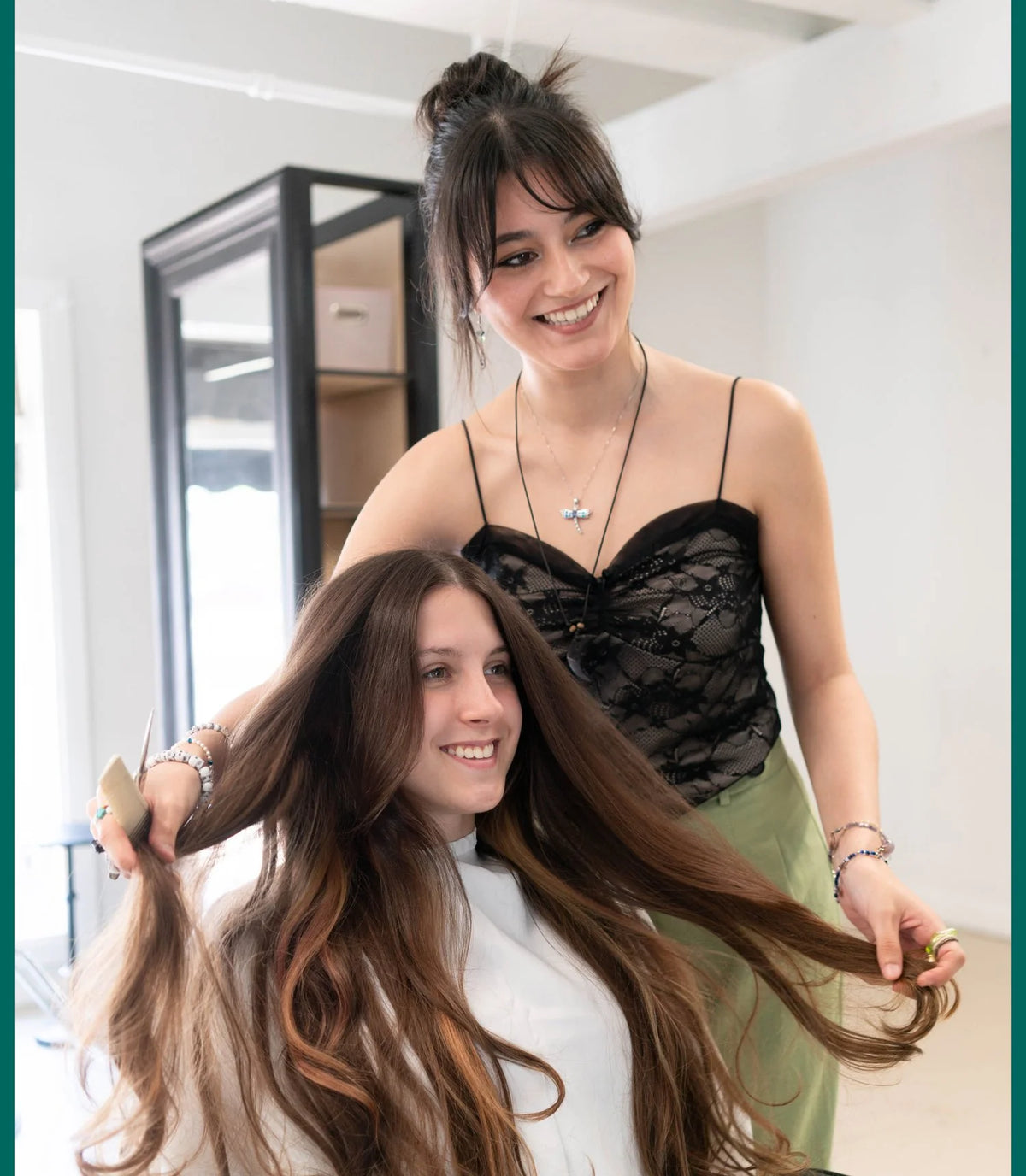
Scissor cut vs clipper cut: which one fits your hair?
Your hair and the finish you want decide this, not the trend of the month. After a consultation, we lay out two paths. Option one is the more involved look. Option two is the easiest version, which keeps upkeep simple. Here is how each tool fits in.
Scissor cut
Scissors suit longer hair, layers, waves and curls, and fine hair that needs to look fuller. They also suit anyone who wants a soft grow-out with no hard line. Amber cuts every texture, curly hair included. One guest had a long layered cut with Amber and wrote on Google that "I still feel fabulous weeks later." That is the grow-out a scissor cut is built for. Scissors are not the tool for a skin-tight edge, though scissor over comb gets close.
Clipper cut
Clippers suit fades, tapers, buzz cuts, short sides on thick hair, and a crisp neckline. They are not the tool for soft, wispy ends or long layered shape. Clippers alone cannot give you that.
Scissors and clippers together
This is the cut most men leave with: clippers on the sides and back, scissors on top. Many women's short cuts use the same mix. Scissors give the overall shape, and clippers give a clean nape or an undercut. Erika Valdez, our owner and executive stylist, specializes in men's grooming, work that leaves no room for error. A mix of tools like this is where that precision shows.
Here is how the two options look for a classic short cut. Option one is a blended fade with a scissor-cut top that you style each morning. Option two is scissor-over-comb sides with a top cut to dry well with a towel and a little product. Both look sharp. One asks more of you.
Fades, tapers and soft layers are easiest to judge in photos, and you can see recent cuts on our Instagram.
How do scissor and clipper cuts grow out?
A tight clipper fade loses its edge first. In our experience it looks sharpest for the first couple of weeks. Then the neckline and the area over the ears start to fuzz, and the blend between guard lengths softens. The shape is still there, but the crispness is gone.
Scissor-cut sides and tops loosen more slowly. Nothing was cut to a hard line, so there is no hard line to lose. Many guests with scissor-cut sides stretch their visits longer before it feels off. The tradeoff is that the shape drifts. Layers fall a little differently as the weight returns.
So tell us how long you plan to wait. If you want a sharp edge every time, we build around a shorter interval. If you want to stretch it, we lean on scissors and a softer taper.
What do people get wrong about clippers and scissors?
Most of the confusion comes from a few habits that show up at the chair again and again.
- Clipper cut means buzz cut. It does not. Clippers run from a bare skin fade to a gentle taper, and the top is usually scissor work.
- Asking for a number 2 and stopping there. The guard number only describes the sides. Tell us what you want on top, or we are guessing.
- Thinking one tool is gentler on your hair. Both tools simply cut it. A clean blade and a steady hand matter more than which one is in the stylist's hand.
- Treating the clipper as the fast option. A good fade takes longer than a one-length buzz because the blending is the work.
What happens in the chair?
Every cut starts with a conversation. We ask how you wear your hair and what bothers you about it. We ask how much time you give it in the morning. We do not rush it.
Fernando focuses on cutting and styling. One guest reviewed a haircut and beard trim with Fernando on Google. The guest wrote that he "paid attention to the details" and "made sure everything was clean, balanced, and exactly how I wanted it." That is the standard we hold clipper work to, where a quarter inch off shows right away.
That standard is not left to chance. Every stylist here trains with Erika, and we hold in-house trainings every week. Our level system shows where each stylist is in their experience, so you can choose the one that fits your cut.
A few things make that first conversation faster and the result closer to what you pictured:
- Bring a photo, ideally one from the front and one from the side.
- Describe the sides, the back and the top separately.
- Tell us how you style your hair on an ordinary morning, not your best day.
- Tell us how often you expect to come back, so we can choose a cut that ages well.
If your visit includes a dry cut, arrive with clean hair worn down, not in a bun. We can then see how it falls on its own before we cut a thing.
Frequently Asked Questions
Are clippers bad for my hair?
No. A clipper blade cuts hair the same way scissors do. Neither tool changes the health of the hair that grows from your scalp. What matters is a clean blade and a stylist who controls it.
Can women get a clipper cut?
Yes. Many women's cuts use clippers for a clean nape, an undercut, or a very short crop. Longer styles stay mostly scissor work, with clippers used only where a sharp edge helps.
What does a number 2 guard mean?
It is a set length for the sides, covered in the guard lengths above. Brands differ slightly, so we show you the length in the mirror before we go shorter.
Can I get both tools in one haircut?
Yes, and most guests do. We use clippers where you want a tight edge and scissors where you want movement. Our service menu lists cuts by service and by stylist level, not by tool.
CTA
Come see us at Zayda Hair & Apothecary on McCullough Ave in Olmos Park, near The Quarry Market. Book your haircut and tell us which tool you are leaning toward. We will walk you through option one and option two. You can also meet the team first.